 All projects
In-house
A desktop AI assistant for macOS: a 3D cat that drives Claude Code by voice, runs several sessions at once, and asks before she acts.
Visit websiteSome developers had started building software just by talking to their terminals. How does that work? Miko Assistant is our in-house macOS app for finding out. It sits between engineers and Claude Code and listens for commands.
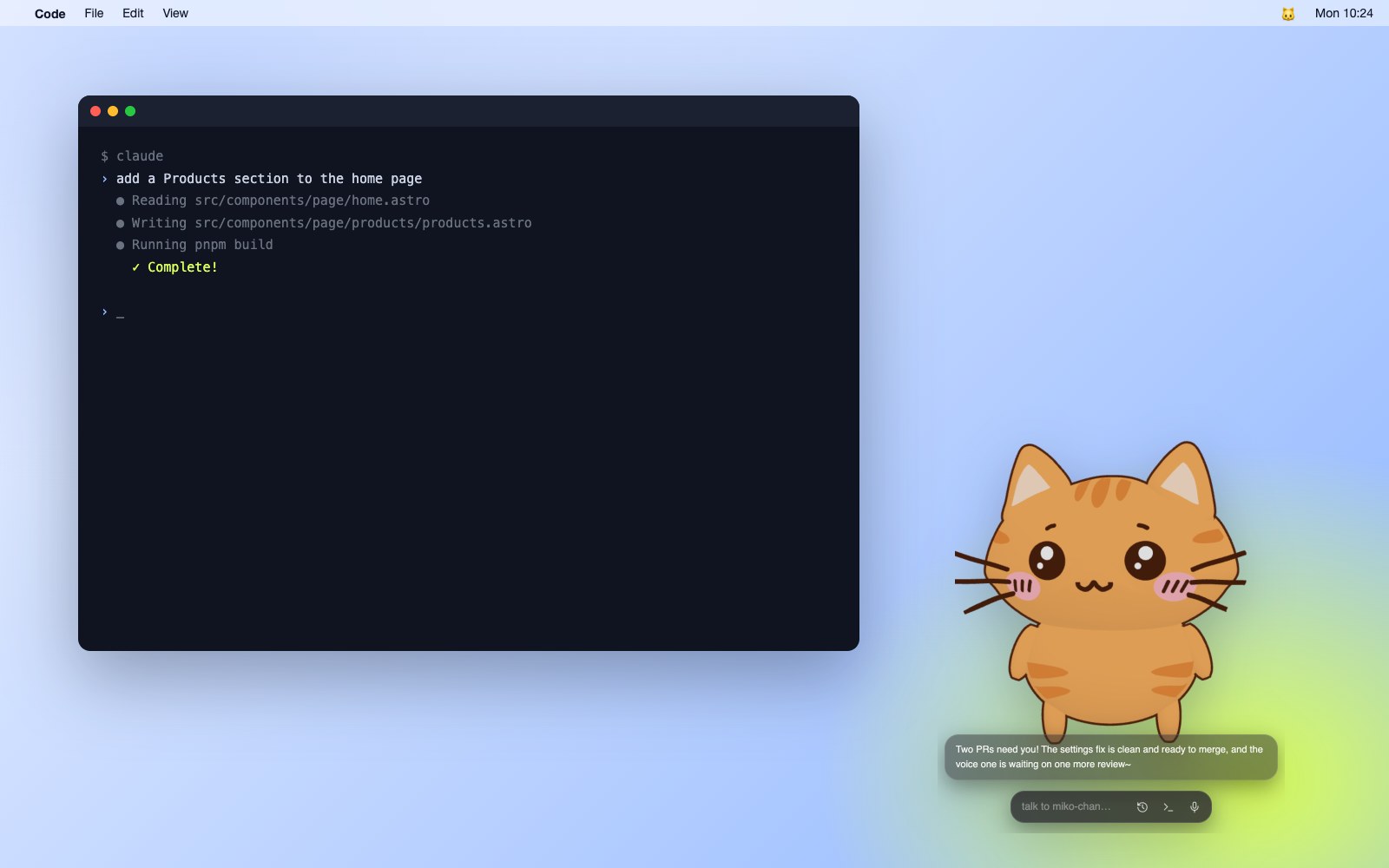
A real session: she answers, then asks before running a command.
The Question
AI coding assistants have accelerated development enormously, but working with them still mostly means typing. AI coding assistants have accelerated development enormously, but working with them still mostly means typing. We wanted to know whether a developer could work with AI entirely by voice and stay productive, with fewer context switches, faster ideas and a more natural conversation with the tools.
What We Built
To support this experiment, we developed Miko Assistant, an internal macOS application designed specifically for AI-assisted software development. Miko Assistant acts as the bridge between the developer and AI coding agents and manages multiple development sessions while enabling hands-free interaction.

She lives on the desktop, next to your terminal.
Voice Coding Integration
One of the key capabilities of Miko Assistant is its voice coding workflow. The application captures spoken instructions through Speech-to-Text (STT), converts them into structured prompts, and forwards them directly to Claude Code. Developers can describe features, request refactoring, explain bugs, or ask implementation questions entirely through voice. Miko Assistant can also read Claude's responses aloud in her own voice, so the exchange stays conversational.

She speaks every reply out loud.
Multi-Session Project Management
Software engineers rarely work on a single task throughout the day. Miko Assistant supports spawning multiple independent Claude Code sessions, allowing developers to work across different repositories or projects simultaneously. Each session maintains its own context, making it easy to switch between tasks without losing conversation history or development state. This creates a more scalable workflow for engineers who regularly juggle multiple projects.

A session that needs you raises its own card.
Asks Before She Acts
Anything outside her allow list raises a card: Allow, Deny or Always. No answer in 120 seconds counts as no. File edits stay inside ~/Documents, and deleting means moving to the Trash, so a misheard command can't do damage.

Miko asking permission to run a command.
A Character, Not a Chat Box
Miko is a 3D cat we modelled in-house. Every reply sets her mood: she waves, dances and spins, and her face follows along. It sounds like decoration, but it is how she shows state at a glance: thinking, waiting on you, or done.


Character animation credits to pixiv Inc.'s VRoid Project.
Looking Ahead
Miko started as an experiment and has stuck around as our internal platform for testing how AI reshapes engineering work. Voice is the first step; autonomous development workflows, smarter project orchestration, and deeper toolchain integration are next.
Technologies
- macOS Native Application
- Claude Code
- Blender MCP
- Tauri
- Rust
- three.js
- VRM
- ElevenLabs
- On-device Speech Recognition